LF Decentralized Trust Lab

A multichain event listener

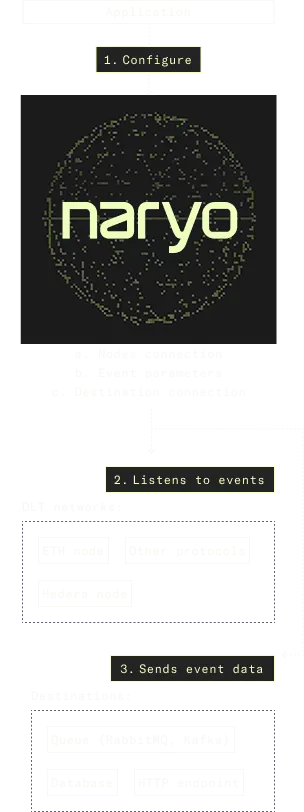
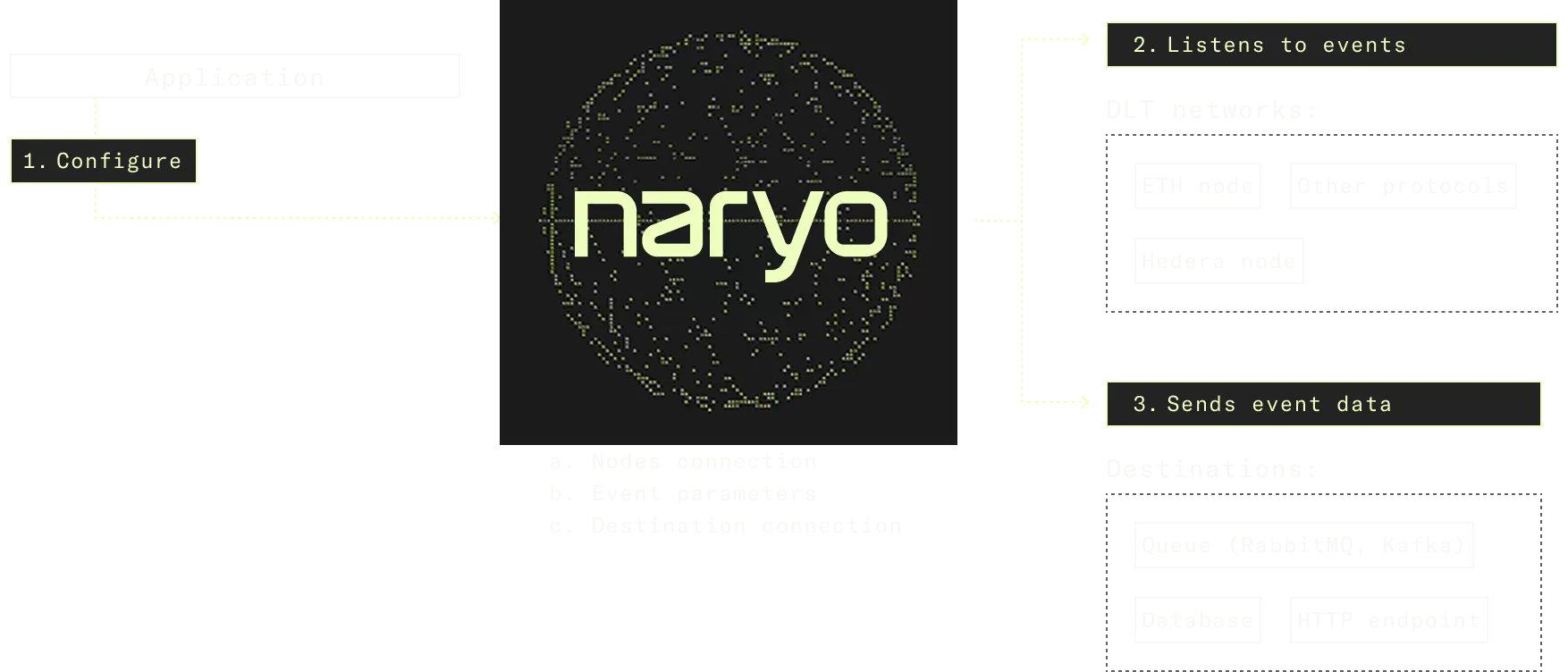
Naryo, an LF Decentralized Trust lab, is an open source tool that handles events emitted by DLT networks. It catches events from multiple networks and broadcasts them to multiple destinations, like databases, queues or HTTP endpoints.

EXPLORE NARYO
N A R Y O
N A R Y O
N A R Y O
N A R Y O
N A R Y O

THE PROBLEM

Why Naryo exists

Time-consuming event handling

Developers spend too much time building and debugging blockchain event listeners.

Low-value engineering work

Event processing is complex but adds little value to end users.

Duplicated effort across blockchains

The same logic must be rebuilt for every network and protocol.

Hard to build reliable real-time systems

Ensuring events are delivered correctly and on time is error-prone.

N A R Y O
N A R Y O
N A R Y O
N A R Y O
N A R Y O

PRODUCT

What is Naryo?

Designed as a backend service, Naryo connects to DLT nodes, filters relevant smart contract and transaction events, and delivers them in real time to enterprise systems such as APIs, queues, or databases, meeting enterprise-grade security and performance requirements.

SEE DOCUMENTATION
Product
N A R Y O
N A R Y O
N A R Y O
N A R Y O
N A R Y O

Value proposition

01

Start managing events in minutes without reinventing the wheel.

02

Simplify your architecture by using Naryo for all your networks, including private ones.

03

Supports Smart Contracts, transactions and blocks events.

04

Self-hosted and open source. No third party dependencies.

05

Dead-simple: easy configuration and deployment.

06

Reliable and scalable: your Dapp won't miss events regardless of volume.

07

Multichain: support EVM and Hiero networks, and more in the future.

08

Versatile: manage event filters dynamically through a simple API.

N A R Y O
N A R Y O
N A R Y O
N A R Y O
N A R Y O

Real-world usage

Naryo, as a basic building block for Web3 applications, is used by our community in a wide range of scenarios.

01

Tokenization platform

Naryo catches all the events emitted by the Smart Contracts of digital assets (funds, stock, bonds and others) deployed in a private Besu network. When new assets are issued and new contracts are deployed, the filters in Naryo are updated in real time to observe the new contracts, without manual intervention.

02

Privacy-enabled networks

In a private Besu network with support for EEA-compliant private transactions, Naryo was extended through a plugin, to catch events emitted by private Smart Contracts. The same instance of Naryo was also used to handle public events emitted by public contracts on that same network.

03

Multichain products

Naryo is deployed as a microservice that sits between the core backend of a multichain tokenization application, and multiple EVM networks and the Hedera public network. When new networks must be supported, the configuration in Naryo is updated to connect to the new nodes and start filtering new events, without altering the code or architecture of the product.

04

Public networks

Naryo is connected to public and consortium networks, such as Base, Palm, and Polygon. The access to the L1s and L2s mainnets is through RPC providers, which are natively supported by Naryo without needing to update its codebase. Naryo also handled large volumes of activities, including NFTs airdrops on public networks.

Get started

Start building with Naryo

N A R Y O
N A R Y O
N A R Y O
N A R Y O
N A R Y O

Naryo is an open source, multichain event listener that captures events from DLT networks and delivers them in real time to applications, databases, queues, or APIs.

Naryo is designed for Web3 and blockchain developers, as well as teams building enterprise or production-ready DLT applications.

It removes the need to build and maintain custom blockchain event listeners for each network, reducing complexity and development time.

Naryo currently supports EVM networks and Hedera, with more DLT protocols planned in the future.

Naryo can process smart contract events, transaction data, and block-level events.

Naryo runs as a backend service that connects to DLT nodes and broadcasts filtered events to your chosen destinations.

Yes. Naryo is fully open source, self-hosted, and has no third-party dependencies or vendor lock-in.

You can get started in minutes by following the README and tutorials available in the project repository.

MORE ABOUT

Backed by

Naryo is maintained by the community at the LF Decentralized Trust.